This is the comparison the RTX 5060 Ti vs 5070 question usually turns into once people notice the 5070 only has 12GB. Both of these cards have 16GB. Both are Blackwell with GDDR7. The difference is that the 5070 Ti moves memory at exactly twice the rate, and costs $420 more to do it.
Quick answer
The two cards run the same models. Anything that fits on a 5070 Ti fits on a 5060 Ti, because 16GB is 16GB. What you buy with the extra $420 is speed: the 5070 Ti’s 896 GB/s against the 5060 Ti’s 448 GB/s shows up as roughly half again as many tokens per second on a local LLM and about the same margin on an SDXL or Flux render. Buy the 5070 Ti if you will feel that speed every day — interactive chat with a 13B, iterating on image prompts. Buy the 5060 Ti if you want the same capability for $630 and are happy to wait a little longer.
Check NVIDIA GeForce RTX 5060 Ti on Amazon→Buy on Shopee SG→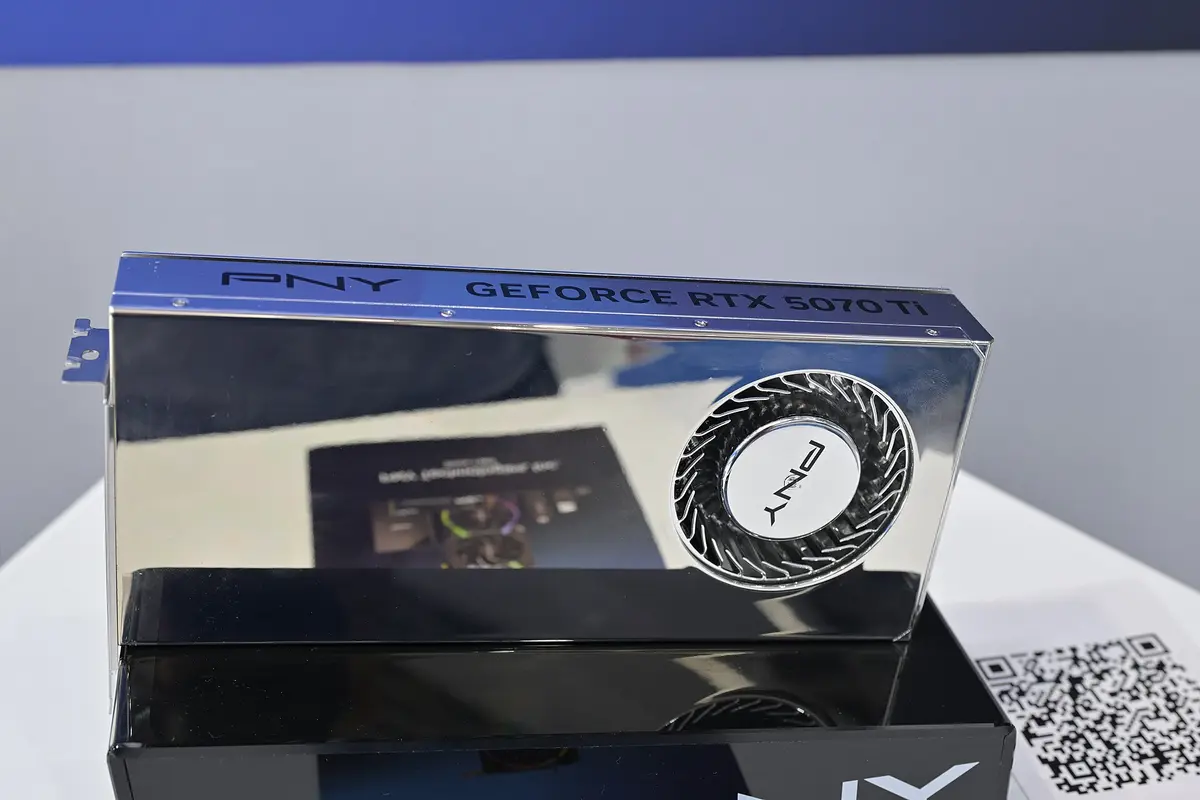
Who this is for
You have settled on 16GB — enough for 13B language models at Q4 and for SDXL and Flux at FP8 — and narrowed it to two Blackwell cards that both offer it. What you are trying to work out is whether the dearer one’s speed is worth $420 to you, or whether the cheaper one gives you the same capability with a slower clock. If you are still deciding whether 16GB is enough at all, read the alternatives section first, because that changes the answer.
Specs comparison
| RTX 5060 Ti 16GB | RTX 5070 Ti | |
|---|---|---|
| VRAM | 16GB GDDR7 | 16GB GDDR7 |
| Memory bandwidth | 448 GB/s | 896 GB/s |
| Memory bus | 128-bit | 256-bit |
| TDP | 180W | 300W |
| Street price | ~$630 | ~$1,050 |
| Price per GB of VRAM | ~$39 | ~$66 |
| 7B LLM, Q4 (modelled) | ~32 tok/s | ~48 tok/s |
| 13B LLM, Q4 (modelled) | ~22 tok/s | ~28 tok/s |
| SDXL 1024px, 25 steps (modelled) | ~6.5s | ~4.3s |
| Flux.1 FP8 1024px (modelled) | ~11s | ~7.5s |
Throughput figures are modelled from memory bandwidth using the method on our methodology page, not measured on a bench; treat them as rankings rather than promises. Prices are September 2026 street prices from our comparison data.
Why the VRAM tie matters more than the bandwidth gap
Most GPU comparisons for AI come down to memory capacity, because capacity decides whether a model loads at all. Here it is a draw, and that removes the usual reason to spend more.
Both cards hold a 13B model at Q4 (7.9GB) with room for a long context. Both hold a 14B at Q8 (16GB) only just, with the cache squeezed. Neither holds a 34B at Q4 (about 20GB), and neither runs Flux.1 at its released BF16 size of 23.8GB — both run it at FP8, around 12GB. Every one of those sentences is identical for the two cards.
So the question is never “which card can run what”. It is “how much is doubling the bandwidth worth to you”.
Where the RTX 5070 Ti wins
Local LLM chat. Token generation is bandwidth-bound: every token requires reading the whole model out of VRAM. At the same 16GB the 5070 Ti’s bus reads it twice as fast, which our model puts at roughly 48 against 32 tokens per second on a 7B. Both are well past the 20 tok/s that feels conversational, but the 5070 Ti stays there on a 13B where the 5060 Ti starts to feel deliberate.
Image generation you iterate on. Diffusion steps also lean on memory throughput. An SDXL render at about 4.3 seconds instead of 6.5 does not sound like much until you are on your fortieth prompt of the evening. Flux at FP8 shows the same margin.
Anything you leave running. Batch jobs, overnight LoRA training on SDXL, serving a model to two or three people — the faster card finishes sooner, and finishing sooner is the entire product.
Where the RTX 5060 Ti wins
Price. $420 is not a rounding error at this tier. It is the difference between the card and a decent used RTX 3060 12GB on the side, or most of the way to a second 5060 Ti.
Power and heat. 180W against 300W. NVIDIA lists a 600W system supply and one 8-pin for the 5060 Ti, against 750W and two 8-pins for the 5070 Ti. If you are dropping a card into an existing office PC rather than building around it, that matters. It is also roughly $3.60 a month less electricity at eight hours a day, or about $44 a year — small, but it compounds against the purchase gap.
Capability per dollar. At about $39 per gigabyte of VRAM it is the cheapest new 16GB card NVIDIA sells. The 5070 Ti is about $66 per gigabyte for the same sixteen.
The 2x bandwidth does not become 2x speed
Worth stating plainly, because the spec sheet invites the wrong conclusion. Doubling bandwidth roughly halves the time spent reading weights, but generation also spends time on compute, on the KV cache, and on the framework itself. That is why our modelled figures show about 1.5x on a 7B and less on a 13B rather than 2x. The 5070 Ti is clearly faster; it is not twice as fast, and $420 buys you a half-again improvement, not a doubling.
Alternatives to consider
- Used RTX 3090 (24GB, ~$820) — sits between the two on price and beats both on capacity. 936 GB/s of bandwidth, more VRAM than either, but 350W, no warranty, and Ampere rather than Blackwell. If 24GB would change what you can run, this is the card the whole comparison is quietly avoiding. See RTX 5070 Ti vs RTX 3090 for LLM for that matchup.
- RTX 4070 Ti Super (16GB, ~$800) — the previous generation’s answer to the same question, and priced between them. We compare it directly in RTX 5070 Ti vs RTX 4070 Ti Super.
- RTX 5070 (12GB, ~$875) — faster than the 5060 Ti and cheaper than the 5070 Ti, but 12GB removes it from this conversation for AI. That comparison explains why.
Which GPU should you buy?
- You mostly run local LLM chat and want it to feel snappy on a 13B: RTX 5070 Ti. This is the one workload where the bandwidth is felt on every single response.
- You run the same models but mainly in batch, or you are fine with a 7B for interactive use: RTX 5060 Ti. Same capability, $420 kept.
- Image generation is your main use: either card, decided by how many prompts you iterate through per session. Under twenty, take the 5060 Ti and pocket the difference; well over that, the 5070 Ti’s shorter renders add up.
- You are not sure 16GB is enough: neither. Look at the used 3090 first, because the extra $420 for the 5070 Ti buys speed, not room, and room is the thing you are unsure about.
Common mistakes to avoid
- Paying for the 5070 Ti to “run bigger models”. It runs exactly the same models. The extra money is for speed alone.
- Reading 2x bandwidth as 2x throughput. The modelled gap is about 1.5x on a 7B and narrower on a 13B. Real, but not double.
- Ignoring the power supply. NVIDIA wants 750W behind a 5070 Ti against 600W for a 5060 Ti. In a system built around the smaller card that is a PSU purchase you did not budget for, and it eats into the $420 you were comparing against.
- Buying either when 24GB is the real requirement. Both are 16GB cards. If your target model is a 34B at Q4 or Flux at BF16, neither works and the used 3090 does.
Final verdict
Check NVIDIA GeForce RTX 5060 Ti on Amazon→Buy on Shopee SG→ Check NVIDIA GeForce RTX 5070 Ti on Amazon→Buy on Shopee SG→Default to the RTX 5060 Ti. For AI specifically, the two cards have the same ceiling, and the cheaper one reaches it for $630. Most people who buy the 5070 Ti for AI are paying $420 for a speed difference they would notice for a week and then stop noticing.
Buy the RTX 5070 Ti if local LLM chat on a 13B is your daily driver, or you render images in volume — the cases where the bandwidth is felt continuously rather than occasionally.
Common questions about the RTX 5060 Ti vs RTX 5070 Ti
Do the RTX 5060 Ti and RTX 5070 Ti run the same AI models?
Yes. Both have 16GB of VRAM, and capacity is what decides whether a model loads. A 13B at Q4 fits comfortably on either, a 14B at Q8 fits tightly on either, and a 34B at Q4 or Flux at full precision fits on neither. The 5070 Ti runs the same models faster; it does not run larger ones.
How much faster is the RTX 5070 Ti for local LLMs?
Roughly half again as fast on a 7B model and somewhat less on a 13B, based on the bandwidth difference — the 5070 Ti has twice the memory bandwidth, but generation is not purely bandwidth-bound, so the gap in tokens per second is smaller than the gap in the spec sheet.
Is the RTX 5070 Ti worth $420 more than the RTX 5060 Ti for AI?
Only if you will feel the speed every day. For interactive chat on a 13B or high-volume image generation, probably yes. For batch work, occasional use, or anything where you would otherwise wait for a job anyway, the 5060 Ti delivers the same results for a lot less money.
Should I buy a used RTX 3090 instead of either?
If 16GB might not be enough, yes. The used 3090 sits between the two on price and carries 24GB, which changes what you can run rather than how fast you run it. Its downsides are power draw, age, and no warranty.